
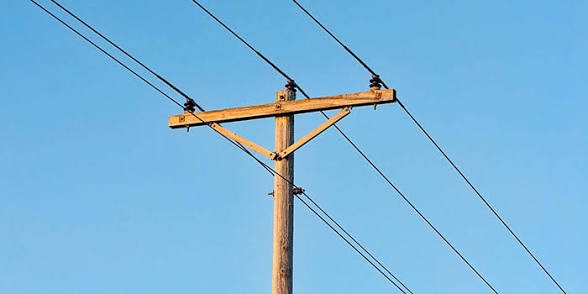
Pole inspections often sit in the category of “routine maintenance”—something scheduled, documented, and assumed to be under control. But in reality, pole infrastructure failures are one of the most underestimated causes of outages, safety incidents, and cascading network disruption in overhead distribution systems.
Whether you’re dealing with distribution utilities, industrial sites, or remote infrastructure corridors, the condition of poles is often a silent risk layer: out of sight, out of mind, until failure forces attention.
The hidden reality of pole infrastructure
Wood and composite poles don’t fail in a single predictable way. They degrade gradually through a combination of:
- moisture ingress
- internal decay (often invisible externally)
- groundline rot
- insect or fungal damage
- mechanical stress from wind, ice, and conductor loading
- hardware degradation (crossarms, brackets, insulators)
The key challenge is that many of these failure modes are not obvious during visual inspection unless you’re specifically looking for them—or using proper testing methods.
Why visual inspections alone are not enough
A walk-by inspection can identify obvious defects like:
- leaning poles
- cracked crossarms
- visible rot or damage above ground
But the most critical failure zone is often below ground level at the groundline, where decay is hidden.
That’s where poles can appear structurally sound while already having significant internal degradation.
Without deeper assessment methods (such as sounding, resistance drilling, or groundline excavation sampling in targeted cases), condition estimates can be overly optimistic.
The real risk: cascading failures
Pole failures are rarely isolated events in operational networks. A single compromised structure can trigger:
- conductor sag or drop
- phase-to-phase contact faults
- downstream protection trips
- feeder outages affecting wide areas
- equipment stress on substations or reclosers
In industrial or mining environments, this can quickly escalate into production downtime, safety risk, and emergency repair escalation.
Why inspection programs fail in practice
Even well-structured inspection programs can fall short due to:
1. Time-based cycles instead of condition-based decisions
Poles are often inspected on fixed intervals rather than actual risk profile.
2. Incomplete asset records
Aging infrastructure may lack reliable install dates, treatment history, or prior inspection consistency.
3. Resource constraints
Large networks often prioritize corrective maintenance over deep inspection work.
4. Data fragmentation
Inspection results may not be consistently integrated into asset management systems.
What a mature pole inspection approach looks like
A stronger inspection framework typically includes:
1. Condition grading system
Standardized scoring for:
- structural integrity
- decay level
- hardware condition
- environmental exposure
2. Groundline assessment focus
Targeted inspection of the most failure-prone zone.
3. Risk-based prioritization
Not all poles are equal—critical feeders and high-consequence locations are prioritized.
4. Environmental risk mapping
Factors like:
- soil conditions
- moisture exposure
- wind loading zones
- vegetation interference
5. Lifecycle replacement planning
Moving from “inspect and react” to:
predict, prioritize, and replace strategically
The cost of missed degradation
The true cost of inadequate pole condition visibility is not just replacement.
It includes:
- emergency repair mobilization costs
- outage duration and lost production (in industrial contexts)
- cascading network faults
- safety exposure for field crews
- regulatory and reputational impact
In many cases, the inspection effort is minimal compared to a single failure event.
The shift happening in modern asset management
Utilities and industrial operators are increasingly moving toward:
- condition-based asset management
- risk-weighted inspection cycles
- digital asset tracking
- predictive maintenance modeling
Pole infrastructure is becoming part of this broader shift, but many networks are still transitioning from legacy inspection models.
Pole inspections are not just about compliance or routine maintenance cycles.
They are about understanding where structural failure risk actually exists in your network—and how it propagates when it occurs.
The difference between a well-maintained network and a resilient one often comes down to how well that risk is understood, not just how often it is inspected.
Leave a Reply